Both promise the same thing: making a small team sound bigger. But they solve the problem in almost opposite ways. One gives you real-time control and demands you get good with your feet; the other gives you studio-level production and locks you into a fixed box. Here's how each one actually works, where each breaks, and which one fits your team.
What live looping is (and how it's used in worship)
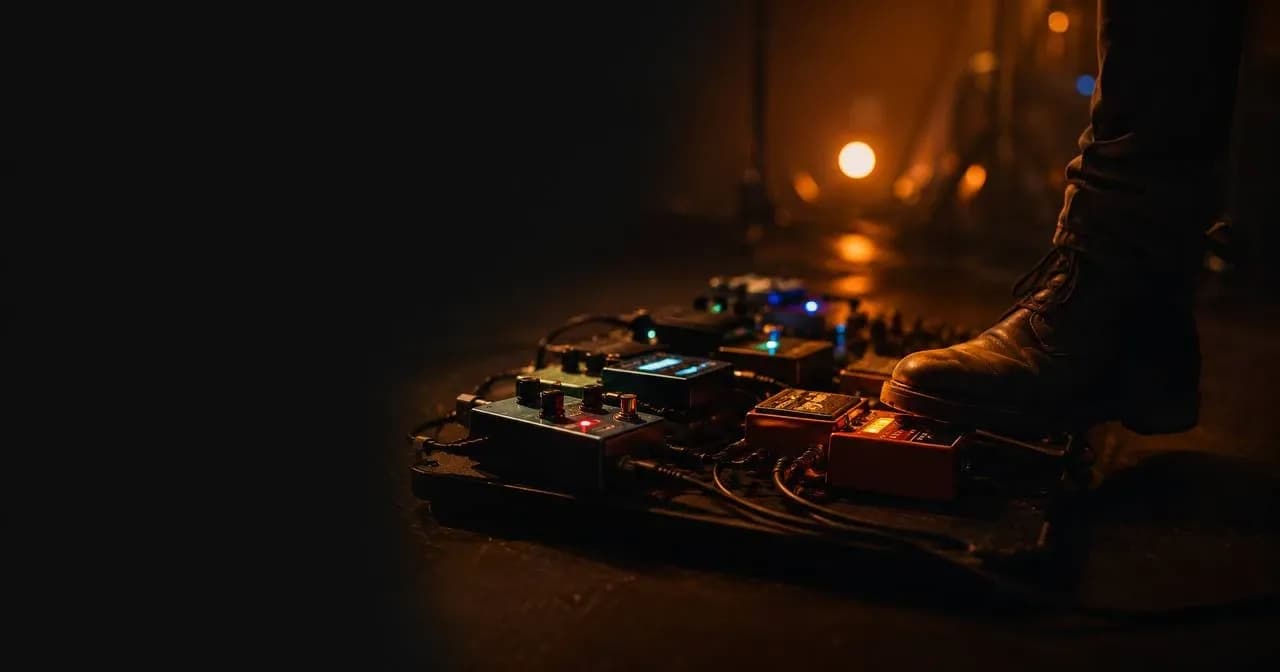
The basic workflow of a loop pedal is simple: press the pedal to start recording a phrase, press it again and that phrase immediately starts playing back on a loop, and while it plays you layer more on top — another guitar, a keyboard pad, mouth percussion, harmonies. The loop's length gets locked in on that first cycle: whatever gap there was between the first and second press.
In worship, this shows up in three main ways. First, the solo leader: with just a guitar or keys and a looper, one musician can build pads and harmonic layers that would normally need a full band — useful on a week without a bassist or drummer. Second, ambient transitions between songs, using the looper to hold a sound bed that connects one song into the next without an awkward cut. Third, and most associated with contemplative or "soaking" worship (the harp-and-bowl model popularized by IHOPKC since 1999), the extended, spontaneous moment: a looper lets you stretch or shorten a section in real time instead of being locked into a fixed-length arrangement.
There are real reference points for this in Christian music. David Crowder Band built songs live around drum loops, with a member dedicated specifically to loops and effects. Phil Keaggy is known for entire improvised looped performances (his album "Roundabout" grew out of loops recorded during soundchecks). And guitarists from Bethel Music, Jesus Culture, and Hillsong stack delays (Strymon Timeline, BigSky) to get ambient swells that sound a lot like a loop, even without a dedicated loop pedal in the signal chain.
One warning worth repeating, from Matt McCoy (founder of Loop Community): a live service in front of the congregation is not the moment to experiment with loops for the first time — rehearse them like you would any new song, before the service.
The gear: from a single loop to multi-track
A simple loop pedal, like the Boss RC-1 or the TC Electronic Ditto, records one single loop: everything you layer on top gets permanently baked in, and "undo" only removes the last pass. Need to redo something further back? You wipe everything and start over. They're mentally cheap to operate — one button, one function — but limited.
Multi-track loopers like the Boss RC-500 (2 independent tracks, up to 13 hours total across 99 memories, MIDI sync) or the Boss RC-600 (6 simultaneous tracks, 9 footswitches, instant recall) let you keep a base loop playing while re-recording just one specific layer, mute and unmute layers independently, and fix a mistake on a single track without wiping the whole arrangement. The Boomerang III Phrase Sampler does something different: it gives you 3 independent loops (expandable to 4), each with its own dedicated footswitch, so you trigger them independently instead of cycling one button through record/overdub/play. For vocalists, there are dedicated options like the Boss VE-20/VE-22, which add up to three-part harmony on top of a short loop.
The real risk: the mistake that repeats forever
Without sync, loops accumulate small timing errors on every cycle — the loop drifts rhythmically further out of time as the song goes on. There's a more immediate problem too: if you flub a layer while recording and don't fix it instantly, that mistake is now trapped in the cycle and will repeat over and over for the rest of the song — there's no way to quietly "fix it" the way a mix engineer can with a fader.
The pedal's learning curve is real too: most people need 10 to 15 attempts before a loop cycle closes cleanly without a stumble. And running a looper live demands so much attention that, according to specialized guides, it can consume your entire mental capacity during a performance — which is why it's recommended that only the most experienced, best-rehearsed person on the team take that role, precisely so the congregation isn't jarred by an audible mistake.
What tracks give you that a loop can't
Looking for multitracks for your team? Explore them on Recursoiglesia.
Browse multitracks →A well-produced track brings elements no solo musician, however skilled with a looper, can recreate live: studio strings, complex synths, layered recorded choirs, special effects. A single contemporary worship song can carry 15 to 20 distinct tracks — click, cues, drums, percussion, choir, pads, synths — all synced and ready to go.
The cost of that is flexibility: once the click starts, the band is locked into the same intro, the same structure, the same ending, every single time. That's the risk several industry sources flag directly — a fully loaded track bed with a small live band can start to feel like "worship karaoke" if the tracks dictate the flow instead of serving it. Looping, by contrast, doesn't tie you to an arrangement — you can extend a section indefinitely and "pastor the room" in real time, while the system simply waits for the next bar to move forward.
Which one fits which team
The industry's guidance here is pretty clear: a loop pedal is built to accompany you playing and singing solo — not to carry a full band. Trying to use a looper to feed an entire live team almost always disappoints; that's exactly what track systems exist for.
Tracks, on the other hand, are explicitly built so any volunteer can run them — Playback's (MultiTracks.com's free app) tagline sums it up: "powerful enough for the largest churches in the world and simple enough for any volunteer." And they serve both ends of the team-size spectrum: there are stripped-down track packages (pad, percussion, lead vocal) built specifically for small teams — a pianist and an acoustic guitarist sounding bigger — and there are also 8-channel setups run by larger, well-organized teams chasing week-to-week consistency no matter who's missing that day.
Can you combine both? Yes
There's a real, documented hybrid technique from Matt McCoy: the track runs start to finish on the drummer's or keyboardist's rig, while the worship leader carries a one-button MIDI controller (Looptimus-style) mapped to repeat a section — a chorus or bridge — without having to cue anyone. The track holds the overall tempo, but the leader keeps a real margin of spontaneous control.
That's possible because several multi-track loopers do sync to external MIDI clock: the RC-500 and RC-600 can act as master or slave to a MIDI clock, chain to each other, or sync to a DAW. The TC Ditto X4 has a MIDI input (though no output) to follow an external clock. And there are cable-free alternatives too, like the TC Ditto Jam X2's "BeatSense," which detects the live band's tempo through a built-in microphone — though with reports it isn't always fully reliable.
What happens when something fails
A loop pedal can fail from timing drift without sync, from latency between the footswitch press and the loop actually triggering, or from mic-based auto-sync misreading a weak rhythmic reference. A track system can fail from software crashing or an arrangement that won't load — real, documented cases from Church Production Magazine, with the standard recommendation to download and verify the whole setlist by Friday or Saturday, never right before the service.
For larger productions, the typical redundancy setup is two synced computers running the tracks with an auto-switching interface (like a Radial SW8), so a crash resolves without the congregation ever noticing the switch. In smaller setups, the advice is to keep two synced laptops for anything you can't recover from with 30 seconds of silence, and avoid switching sessions mid-show — switching scenes within the same file is far safer.
With all of this laid out, the decision gets simpler: if you have a solo leader or intimate, spontaneous moments, the loop pedal is the right tool. If you need full production and week-to-week consistency no matter who's leading, tracks win. And if your team is growing, the hybrid technique — tracks for structure, a loop button for spontaneous margin — gives you the best of both.
Explore more resources to elevate your worship at recursoiglesia.com, where you'll find multitracks, charts, templates and more. And follow us so you never miss a release: on Instagram and Facebook as @recursoiglesia.